
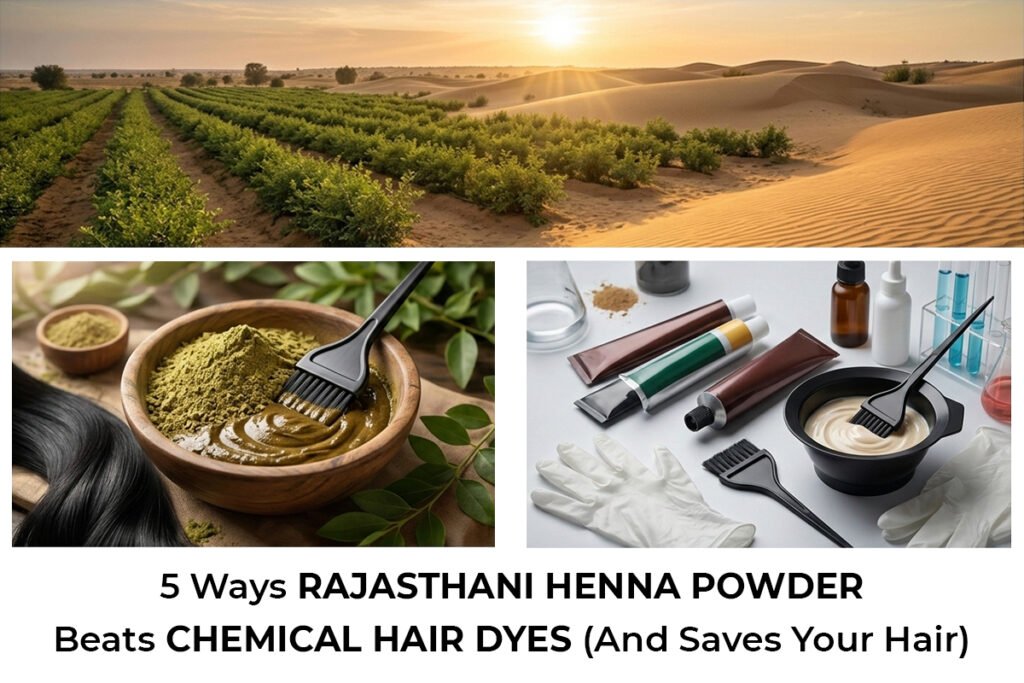
5 Ways Rajasthani Henna Powder Beats Chemical Hair Dyes (And Actually Saves Your Hair)
My friend Sarah colored her hair every six weeks for eight years. Salon appointments. Foils. The whole routine. By the time she hit her mid-thirties, her ponytail had gone from thick to barely-there. Her stylist told her something she did not want to hear: “You need to stop.”
She switched to henna from Rajasthan. That was three years ago. Her hair has grown back thicker. She does her own coloring at home. She spends approximately $150 a year instead of $1,200.
I’m not saying henna is magic. But there’s a reason women across the USA — and honestly, across the world — are ditching the box dye and the salon chemicals. Let me break it down.
First, it helps to understand what henna actually is — because a lot of people confuse real henna with the synthetic black stuff sold at craft fairs. They are not the same thing at all.
What’s Actually in That Box of Chemical Dye?
Let’s start here, because this part matters.
Most commercial hair dyes — the ones you buy at CVS or get applied at a salon — rely on ammonia and hydrogen peroxide to do their job. Ammonia forces open the hair cuticle. Peroxide bleaches out your natural pigment. Then, synthetic color gets pushed deep into the hair shaft.
It works. You get color. But here’s what else you get: the cuticle never fully closes again. Repeat this every 6 weeks for a few years,s and the cumulative damage adds up. Dry texture. Breakage. Thinning near the temples. Sound familiar?
PPD — para-phenylenediamine — is another common ingredient. It’s the chemical that makes dark shades dark. It’s also a known allergen that causes reactions in a growing number of people, sometimes severe ones.
Why Sojat, Rajasthan? (Not Just Any Henna Will Do)
Here’s something most buyers don’t know. The henna plant grows in many parts of the world. But henna from the Sojat region of Rajasthan, India, has a naturally higher concentration of lawsone — the compound responsible for color. More lawsone means stronger stain, richer tone, and longer wear.
The dry, hot Rajasthan climate is essentially perfect for the plant. Farmers there have been cultivating it for generations. The harvest timing, the drying method, the milling process — all of it contributes to a final product that’s significantly better than generic henna sold under vague “natural” labels.
This is worth knowing before you buy anything. Not all henna is equal. Where it comes from, and how it’s processed, changes everything.
5 Reasons the Switch Makes Sense
1. It doesn’t destroy what’s already there
Chemical color works by breaking down your hair’s existing structure. Henna doesn’t. It deposits color on the outside of each strand without lifting or stripping anything. Your hair keeps its natural proteins intact.
This sounds like a small thing. It isn’t. Hair that hasn’t been chemically stripped holds moisture better, breaks less, and stays thicker over time. Women who’ve made the switch often notice the difference within a few months — not in color, but in feel. The hair just behaves differently. Better.
For people with a sensitive scalp, this matters even more. No burning. No tingling. No post-color scalp dryness.
2. Color and conditioning happen at the same time
One of the more surprising things about natural henna is that it contains tannins — plant compounds that bind to the keratin in hair and actually strengthen it. So while you’re sitting there waiting for the color to develop, the henna is also acting as a deep conditioning treatment.
Compare that to a chemical process that requires a separate deep-conditioning step afterward just to undo some of the damage it caused.
Women who’ve been using henna regularly for a year or two often describe their hair as “thicker” and “heavier.” That’s not just perception. The fiber is genuinely more reinforced.
3. The color sticks around longer
This one surprises people. They assume natural = weaker. But the lawsone in henna bonds directly with the keratin protein in your hair. That bond doesn’t wash out easily. In fact, the color from a good henna treatment often deepens slightly over the 48 hours after you rinse.
Chemical color, on the other hand, starts fading almost immediately. By week four, roots are showing, and the mid-lengths look duller and brassier than when you walked out of the salon.
With henna, most users comfortably go 7–9 weeks before a touch-up. Some go longer. And when you do reapply, the process isn’t stripping anything — it’s just adding more.
The key is quality powder. Coarsely milled henna leaves gaps in coverage. Triple-sifted henna powder — milled three times to remove stems and rough particles — gives even, consistent coverage from root to tip. That’s one reason certified exporters like Kirpal Export Overseas emphasize processing quality as much as plant quality.
4. You can use it as often as your hair needs it
Chemical dyes come with a waiting period for good reason. Overlapping colors too soon causes serious breakage. The instructions usually say four to six weeks minimum — and even that can be pushing it for fragile hair.
There’s no such ceiling with henna. You can do it every few weeks if you want. The effect is cumulative and positive rather than cumulative and damaging. Curly-haired women, in particular, have taken to it because curly hair tends to be drier and more fragile — exactly the hair type that benefits most from henna’s conditioning properties.
For people who use it on their hands for traditional body art, the same logic applies. Regular use doesn’t irritate. It’s gentle enough for skin contact, which tells you something about how it behaves on your scalp, too.
Want to understand more about what sets this region’s henna apart from everything else on the market? This piece does a good job of explaining it: What Makes Rajasthani Henna Powder the Best.
5. The cost difference is genuinely hard to ignore
Let’s talk numbers for a second.
A standard salon color appointment in a mid-size US city runs $90–$150 per session. Do that every six weeks,s and you’re spending $780–$1,300 a year. That doesn’t count tips, travel, or the deep conditioning treatments you’ll need afterward.
A quality henna kit from a certified supplier costs $15–$30 for enough product to do 2–3 applications. Even if you buy it ten times a year, you’re at $150–$300 tops — and your hair is in better shape than it was when you started.
Beyond personal savings, there’s also the environmental picture. Chemical dye production generates synthetic waste. Henna is a crop. It’s farmed, dried, milled, and packaged. When it comes from a supplier committed to clean practices — like those with ISO and GMP certifications — the footprint is dramatically smaller.
| Salon Chemical Dye | Henna at Home | |
|---|---|---|
| Cost per session | $90–$150 | $15–$30 |
| Sessions per year | ~9 | ~7 |
| Estimated annual spend | $810–$1,350 | $105–$210 |
| Post-treatment conditioning needed | Yes | No |
| Environmental impact | High | Low |
The Kirpal Export Overseas Story (A Quick Case Study)
Kirpal Export Overseas — known in the trade as KEO — has been running since around 2000. Founder Mr. Sunil Walia built it from a single focus: sourcing henna from Sojat farms and getting it to buyers who care about purity.
Today, ay the company ships to markets in North America, Europe, and beyond. They carry ISO, GMP, and HALAL certifications — which matters a lot for buyers in regulated markets like the USA. They offer OEM and private-label packaging, too, which is why a number of American natural beauty brands source from them without customers ever knowing it.
What makes KEO worth mentioning here isn’t just their volume. It’s the vertical structure. They photograph their farms. Buyers can see where the henna comes from. That kind of traceability is rare in commodity supply chains and increasingly important to today’s conscious consumer.
If you’re curious how Sojat henna ended up on shelves in New York and Los Angeles, this is a good read: How Rajasthani Henna Powder Went Global.
And for anyone sourcing in bulk — salon owners, brand founders, distributors — here’s a current guide on wholesale henna powder manufacturers to trust in 2026.
What to Actually Look for When Buying
This section matters because the henna market in the USA is messy. There’s a lot of mislabeled, adulterated, or just plain low-quality products out there. Here’s what to check:
Origin matters. If the label doesn’t say Sojat or Rajasthan, ask. Generic “Indian henna” with no source region named is a flag.
Avoid anything labeled “black henna.” Real henna is brown-green in color. Black henna almost always contains PPD — the same chemical allergen in synthetic dyes. It’s not natural,l and it’s not safe.
Check the processing method. Triple-sifted powder has a noticeably different texture — smooth, fine, easy to mix. Coarse or grainy powder won’t apply evenly.
Look for third-party certifications. ISO and GMP are the standards for export-grade products. HALAL certification adds another layer of verification for ingredient purity.
For wholesale buyers in the USA: pricing, minimum order quantities, and lead times vary a lot by supplier. Do your due diligence. Sample before you commit. And read the natural beauty sourcing trends shaping what American consumers want right now.
Honest Answers to Common Questions
Will henna cover gray hair? Yes, but it gives gray a reddish-orange tone rather than a neutral brown. If you want brown or black, you’d blend henna with indigo powder. Some suppliers offer pre-mixed herbal blends specifically for gray coverage.
Can I use henna over chemically colored hair? Yes, with one caveat. If your hair has been colored with metallic dyes — common in some box colors and henna kits sold at dollar stores — the interaction can be unpredictable. Do a strand test first. For hair colored with standard salon oxidative dye, henna typically works fine after a few weeks of waiting.
How long does it take? You mix the powder into a paste, apply it, and leave it on for 2–4 hours, depending on the depth of color you want. Then rinse. Color develops fully over the next 24–48 hours.
Is it safe during pregnancy? Pure henna is generally considered safe for topical use. But pregnancy is pregnancy — check with your doctor before changing any personal care routine.
Where do USA buyers order from? Directly from certified Indian exporters is the most reliable route for quality and pricing. You can browse options at Kirpal Export Overseas’s product page for reference on what a verified supplier looks like.