
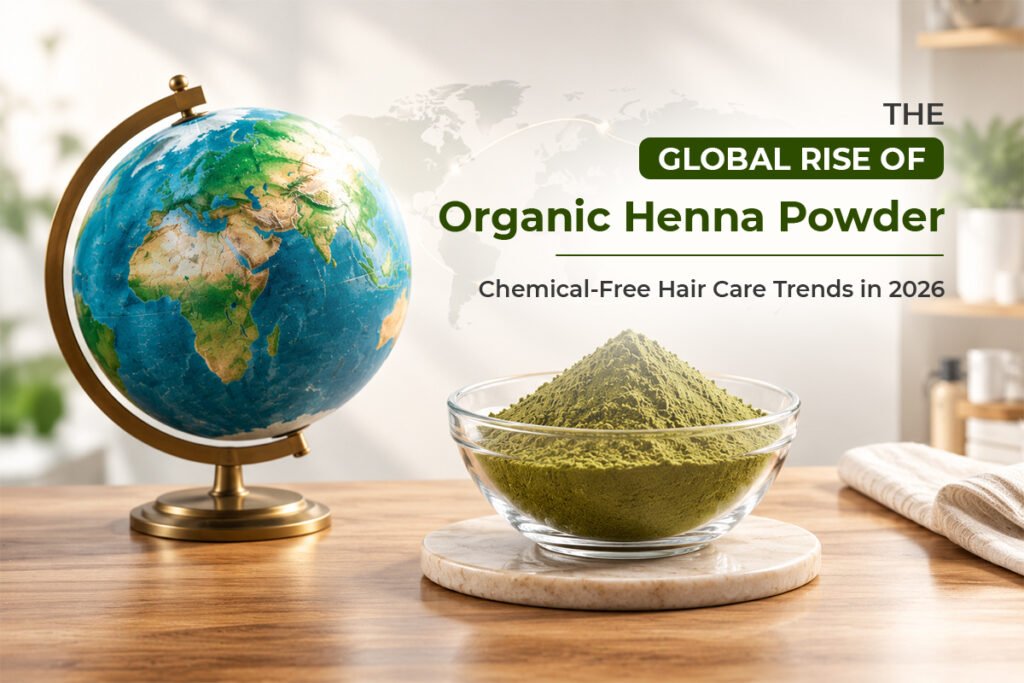
What does a pharaoh with a passport have in common with this autumn’s loudest hair trend? In 1976, the mummy of Ramesses II flew to Paris for conservation work and was met by an army detachment. Nineteenth-century Egyptologists had already recorded hair tinted light red and hands and feet stained with henna. Later microscopy suggested he had been a natural redhead in his youth. More than three thousand years on, beauty editors are calling copper, cinnamon and deep auburn the colour story of autumn 2026. So is the leaf behind that ancient stain ready for a comeback too?
Largely, yes, and the commercial case is stronger than the fashion case. Organic henna powder is the dried, milled leaf of Lawsonia inermis, and it colours hair in the red-to-brown range. For importers, salons and private label brands, the real question is which henna powder manufacturers can prove purity with documents rather than adjectives. This guide covers the shades, the rules and a buying checklist.
Why Is Auburn Suddenly Everywhere in 2026?
Fashion rarely asks permission. This season, red and copper tones have pushed past blonde in the beauty press, with shades such as baby copper, burnt copper and deep auburn hair colour leading the conversation. Colourists quoted in fashion magazines give practical reasons too: healthier-looking hair, lower upkeep and a polished look. Stylists also describe copper as one of the most demanding shades to maintain, which is a gentle way of saying it fades quickly.
That is where natural henna enters the story. Its pigment, lycopneumone, binds to the keratin in hair and gives it black.
- Longevity varies. Colour usually fades gradually over several weeks, depending on hair porosity, washing habits and heat styling.
| Colour goal | Typical botanical approach | What the buyer should specify |
|---|---|---|
| Copper or auburn | Henna alone, or a henna-led blend | Intended application and shade range |
| Chestnut or deeper brown | Henna combined with indigo | Blend ratio and mesh size |
| Near black | Henna and indigo applied in stages, or a ready blend | Whether single-step or two-step |
What Is Driving the Move Away From Conventional Dyes?
Three forces are pulling in the same direction. Shoppers are reading labels, with ammonia-free and PPD-free claims now familiar at the shelf. Brands want a plant-based hair dye story that survives scrutiny. And regulators are tightening the language.
On that last point, the EU’s Empowering Consumers for the Green Transition Directive has applied to traders since 27 September 2026. Generic environmental claims such as “natural” or “eco-friendly” now need real substantiation, and that covers retailers and own-label products too. The phrase “chemical-free” is its own puzzle. Lawsone is a chemical, and so is water. What a careful brand actually means is that nothing synthetic has been added, and it needs paperwork to say so.
For buyers shipping to the United States, the brand owner is typically the “responsible person” under MoCRA, which covers product listing, safety substantiation and adverse-event reporting. You will need ingredient declarations and batch records from whoever makes the product. Hair dye manufacturers and hair colour suppliers who can hand those over quickly tend to be the ones worth talking to.
Why Do Buyers Source From Sojat and India?
Sojat, in Rajasthan, is one of India’s established henna-growing areas, and many henna manufacturers in India process leaves grown in that region. That is why searches for henna powder manufacturers in India and henna suppliers in India come from importers on every continent. Origin is a starting point, not a guarantee, so the checklist below still applies. If you want to see how an exporter presents its range, the Henna Manufacturers in India site shows a full product line from one source.
How Should You Choose Among Henna Powder Manufacturers?
Directory listings for henna tend to repeat the same absolutes: “100% natural”, “safe for all skin types”, “no chemicals”. Those words are free. Documents are not. A better approach is to ask each of the henna suppliers on your shortlist for the same set of papers and compare the answers.
| Ask for | Why it matters |
|---|---|
| Ingredient declaration | Confirms a single plant ingredient, not a blend with hidden additions |
| Certificate of Analysis (COA) | Batch-level evidence that matches your order |
| Heavy metal test results | Plant powders can pick up contaminants. |
| Microbiological test results | Shows hygiene and shelf stability |
| Specification sheet | Fixes the grade, texture, and intended use |
| Batch documentation | Supports traceability if a question arises later |
Two cautions save money. First, always state whether the powder is for hair colour or for body art, because the grades and rules differ. Second, treat “black henna” with suspicion. Natural henna stains in the red-to-brown range, and the label can cover products containing other ingredients. If your buyers include people with reactive skin, this guide on what to ask henna powder manufacturers about PPD, testing and labels goes deeper on that side.
What Does a Bulk Order Look Like in Practice?
A sensible bulk henna powder purchase follows a short sequence:
- Define the use. Hair colour, salon service, retail pack,k or body art.
- Name the destination. Documentation requirements change by market.
- Request the documents. Specification sheet, COA, heavy metal and microbiological results.
- Test a sample. Run a strand test and a small mixing trial before committing.
- Confirm packaging and quantity. Then agree on the final specification before production.
On packaging, one Sojat-sourcing exporter’s page for organic henna powder from Sojat is a useful reference. It describes a triple-sifted powder in retail pouches of 100 g, 500 g and 1 kg, with bulk packs of 20 to 25 kg. It also mentions an LDPE inner pouch with composite aluminium foil where applicable, and it says samples, private-label packaging and testing according to specification are available. Read that as a template for the questions you should ask anyone, not as a reason to skip them.
How Does Private Label Fit In?
Pure powder is only one product. Many brands want their own range, and that is where private label and OEM work begin. A good partner can discuss custom formulation, herbal blends of henna, indigo, go, and other plants, and packaging and branding in the same conversation. If you are building a line rather than buying a single SKU, look at private label hair colour manufacturers who state ISO, GMP and HALAL certifications and can support batches with a Certificate of Analysis. Ask for current copies before you order, as you would with any partner.
One more point for brand owners: the claims you print are yours. A pack that says “organic” needs a certification behind it, and a pack that says “sensitive scalp” needs your own safety evidence.
What Mistakes Do Buyers Make Most Often?
- Buying on adjectives. “Premium” and “pure” are not specifications.
- Skipping the sample. A strand test costs little and prevents a very orange surprise.
- Ignoring the end market. A pack that works in one country may need different wording in another.
- Assuming all henna is the same. Grade, sifting, and intended use all change the product.
- Forgetting the colourist. Tell salon partners about henna use, because some products sold as henna contain metallic salts that can react with other treatments.
Frequently Asked Questions
Q: Does henna give auburn hair?
A: Yes, in the red-to-brown range. Pure natural henna typically gives copper and auburn tones on mid-to-dark hair, and the exact result depends on your starting colour and the application. A strand test is the safest way to preview it.
Q: How long does henna hair colour last?
A: It usually fades gradually over several weeks, depending on hair porosity, washing habits, and heat styling. Colour-safe, sulphate-free shampoos are commonly recommended to slow the fade.
Q: Why does henna look orange at first?
A: Fresh henna often appears orange and then deepens toward reddish brown over a day or two as it oxidises. That is normal, and it is why shade promises should wait until the colour has settled.
Q: Can I use henna on blonde or bleached hair?
A: You can, but expect strong orange tones. Very light hair takes up colour readily, so a strand test comes first.
Q: Can I use chemical dye after henna?
A: Pure henna is a plant, but some products sold as henna contain metallic salts, and salon professionals often caution about those. Tell your colourist, and request the ingredient declaration from your henna powder manufacturers.
Q: What is the difference between natural henna and black henna?
A: Natural henna comes from Lawsonia inermis leaves and stains in the red-to-brown range. “Black henna” can refer to products with other ingredients, so the declaration matters more than the name.
Q: What documents should I request from henna manufacturers?
A: Ask for a specification sheet, a Certificate of Analysis, heavy metal and microbiological testresults, ingredient informationo,n and batch documentation. Confirm that current copies match your order.
Q: Can I launch my own henna range?
A: Yes, through private label production with custom packaging and branding. Back every claim you print with your own evidence, and avoid absolute words such as “safe” or “chemical-free”.
The Bottom Line
Auburn may be this season’s trend, but the opportunity behind it is steadier: buyers who want colour from a leaf and want proof alongside it. The sensible next step is to shortlist suppliers, request the documents above and run a sample before you scale up. For the story of how one exporter’s founder describes the business, the founder’s own page is a worthwhile read. If you would like to compare options or start a conversation, begin with a henna supplier that exports worldwide. This article is educational and does not replace professional advice.