
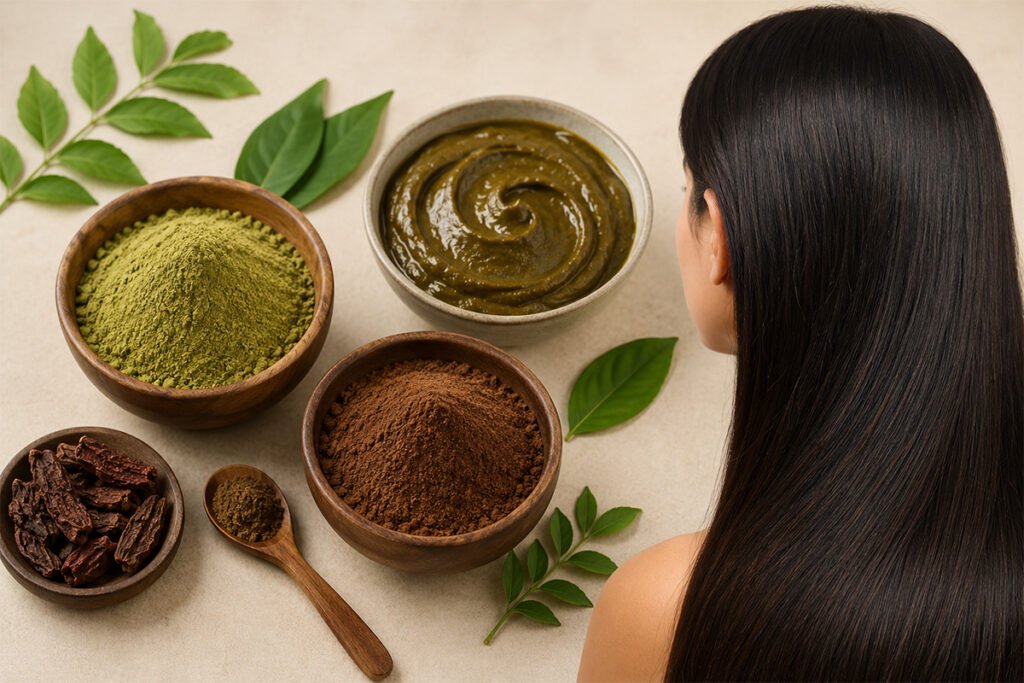
Answer Capsule: Shikakai powder cleanses the scalp through natural saponins while henna binds lawsone dye directly into the hair shaft for color and strength. Mixed at a 3:1 or 2:1 henna-to-shikakai ratio, the blend delivers cleansing and copper-toned color in one sitting — no sulfates, ammonia, or PPD. For full color depth, let henna complete its acid-based dye release first, then fold in shikakai just before application. Most blends sit on hair for 60–90 minutes and rinse clean with water alone, with results building over two to three uses.
What Is Shikakai Powder and Why Is It Used in Hair Care?
Shikakai powder comes from the dried, ground pods of Acacia concinna, a climbing shrub native to South Asia. Long before synthetic shampoo existed, households used it as a scalp wash — and the reason it worked comes down to chemistry, not just tradition.
Shikakai pods carry a moderate concentration of natural saponins, plant compounds that act as mild surfactants. Saponins lift sebum and product buildup from the scalp the way soap does, but shikakai’s pH sits closer to the scalp’s own mildly acidic range (roughly 5.5–6.5) rather than the alkaline range of bar soap or the aggressive stripping action of sodium lauryl sulfate. That pH proximity is why regular users report less post-wash tightness and less oil rebound compared with sulfate shampoo. Shikakai carries no dye pigment and no film-forming conditioners — its entire function is cleansing without collapsing the scalp’s natural oil balance.
How Shikakai and Henna Work Differently on Hair and Scalp
They are not interchangeable, and knowing where each one acts explains why the mixing order matters more than the mixing itself.
| Function | Shikakai Powder | Henna |
| Primary role | Surface cleanser | Dye and conditioning agent |
| Site of action | Scalp surface and outer cuticle | Cortex (inner hair shaft) via lawsone binding |
| Active mechanism | Saponin-based surfactant action | Lawsone molecule oxidizes and binds to keratin |
| pH requirement | Mildly acidic to near-neutral | Needs an acidic medium (~pH 4.5–5.5) to release dye |
| Effect on hair color | None — carries no pigment | Deposits copper-to-auburn tone based on lawsone content |
| Rinse behavior | Fully water-soluble | Can leave particulate residue if not sieved and strained |
Henna never gets “help” coloring from shikakai — shikakai has no colorant role at all. Its only interaction with henna is procedural: when it enters the paste, not what it contributes to the paste.
Benefits of Mixing Shikakai Powder with Henna
- Combines cleansing and coloring into one application, removing a separate pre-wash step
- Reduces the flat, coated feel some pure-henna users report, since saponins prevent excess dye particulate from clinging to the shaft
- Smooths the cuticle layer, which shows up visually as shine
- Replaces sulfate shampoo and ammonia- or PPD-free dye alternatives entirely
- Pre-cleans the scalp surface ahead of dye contact, improving even color uptake by clearing sebum and styling-product film that would otherwise block lawsone from reaching the cuticle
Best Way to Prepare Shikakai and Henna Hair Paste
Most information gaps in existing content skip the sequencing problem entirely — mixing everything together from the start. Here’s the sequence that actually protects color depth:
- Sieve both powders separately. Pass henna through an 80–100 mesh sieve and shikakai through a 60–80 mesh sieve. Unsieved shikakai contains coarse pod fiber that scratches the scalp during application and removal.
- Start henna’s dye release first, alone. Mix sieved henna with an acidic liquid — strained lemon juice, amla water, or a cooled black tea decoction — to a smooth, lump-free paste. Cover and rest at room temperature (roughly 25–30°C) for 6–12 hours. This step, sometimes called dye release time (DRT), is what converts inert lawsone into its active, hair-binding form.
- Fold in shikakai only in the final 1–2 hours, once dye release is visibly complete (the paste darkens and takes on a distinct earthy smell). Add warm water as needed to loosen the shikakai fiber and bring the mix to a smooth, yogurt-like consistency.
- Strain through muslin cloth before application to remove any undissolved pod fragments — this single step prevents most of the scalp micro-irritation associated with shikakai blends.
- Apply to clean, dry, product-free hair, working from roots to ends, and cover with a shower cap to retain warmth during processing.
Ideal Mixing Ratio for Shikakai and Henna
| Goal | Henna : Shikakai Ratio | Notes |
| Maximum color intensity | 4:1 | Minimal cleansing effect; best for color-priority applications |
| Balanced color + cleanse | 3:1 | Standard starting ratio for most hair types |
| Scalp-focused cleanse, lighter tone | 2:1 | Best for oily scalps needing more surfactant action |
| Sensitive skin or first-time use | 3:1 with patch test | Test on inner forearm 48 hours before scalp application |
Does Shikakai Change Henna’s Color Results?
Not directly — but timing changes it indirectly, and this is where most guides get it wrong.
Myth: Shikakai has bleaching or color-altering properties that lighten henna’s tone.
Fact: Shikakai carries no pigment and cannot chemically bleach dye. What it can do is dilute the acidic environment henna needs during dye release if added too early. Adding shikakai from hour zero introduces water and mild surfactant action into a mix that needs sustained acidity to convert lawsone into its dye-active form — the result is a lighter, less saturated final color, not because shikakai “faded” anything, but because dye release was interrupted before it finished. Add shikakai only after the dye-release window closes, and color saturation holds at the same level as a henna-only application.
How the Blend Affects Grey Hair Coverage
Grey hair coverage with henna alone produces a copper-to-orange tone, since henna’s lawsone molecule doesn’t carry the darker pigments needed for brown or black results — that requires layering indigo in a henna-indigo two-step method. Shikakai plays no role in shifting that base tone.
Where shikakai does help: grey and white strands are typically more porous and often carry more accumulated styling-product residue than pigmented hair, both of which can cause uneven dye uptake — patchy or blotchy coverage rather than a solid tone. Shikakai’s cleansing action, applied correctly in the final mixing stage, clears that residue layer so lawsone contacts the cuticle more evenly across grey sections. The practical result is more consistent — not darker — grey coverage.
Shikakai and Henna for Dry, Oily, and Sensitive Scalp Types
| Scalp Type | Adjustment | Reasoning |
| Dry scalp | Lower shikakai ratio (toward 4:1), add 1 tsp coconut or amla oil to the paste, shorten leave-on time | Reduces additional surfactant contact that can compound dryness |
| Oily scalp | Higher shikakai ratio (toward 2:1) | Saponin action targets excess sebum more directly |
| Sensitive scalp | Always sieve and strain fully; patch test 48 hours ahead; skip additives like clove or eucalyptus oil | Coarse fiber particles and essential oil additives are the most common irritation triggers, not the powders themselves |
How Long to Leave the Mixture on Hair
Separate the two timers — they aren’t the same thing:
- Dye-release resting time (off-scalp): 6–12 hours for the henna-only base paste, before shikakai is added
- On-scalp application time: 60–90 minutes for a henna-shikakai blend, generally shorter than a henna-only application because the softened cuticle from shikakai’s cleansing action allows faster lawsone contact
Don’t let the applied paste dry out and crust on the hair — a cracked, fully dried paste is harder to rinse cleanly and pulls more strands during removal than a paste kept slightly moist under a cap.
Aftercare Tips to Keep Hair Soft and Manageable
- Rinse with water only for the first 24–48 hours; skip shampoo to let color oxidation finish settling into the cuticle
- Avoid sulfate shampoo on the first wash after treatment — it can strip freshly bound dye before it fully sets
- Seal ends with a light oil (coconut or argan) once hair dries, since the mixture can leave hair feeling slightly drier immediately after rinsing
- Skip heat styling for the first wash cycle
- Detangle gently with a wide-tooth comb; henna-shikakai paste temporarily increases hair’s fiber weight
Common Mistakes to Avoid When Using Shikakai with Henna
- Adding shikakai from the start instead of after dye release — the single most common cause of disappointing color depth
- Using compound or “instant” henna — boxed products labeled henna often contain metallic salts for faster color; layering shikakai or any subsequent treatment on top without a strand test can trigger unpredictable reactions
- Skipping the sieve and strain steps, leaving coarse fiber particles that scratch the scalp
- Treating shikakai as a shampoo replacement for daily washing — it’s formulated for periodic deep cleanse-and-color sessions, not routine use
- Letting the applied paste dry out under an uncovered head, making rinsing difficult and pulling strands
Who Should and Should Not Use This Mix
Good fit for:
- Anyone seeking chemical-free color with a combined cleansing step
- Normal-to-oily scalps
- Buyers formulating PPD-free or ammonia-free color lines
Use caution or avoid:
- Chemically relaxed, permed, or recently bleached hair — porosity differences can cause uneven or unexpectedly intense color; strand-test first
- Known allergy to Acacia or the broader Fabaceae plant family
- Hair recently treated with metallic-salt “instant” henna — strand-test before layering
- Anyone with an active scalp condition (psoriasis, eczema, open lesions) — consult a dermatologist before applying any plant-based paste to broken skin
Sourcing Shikakai Powder and Henna for Commercial Use
Private label brands, salon chains, and herbal formulators scaling a shikakai-henna product line need supply consistency that home recipes don’t require — verified lawsone content, batch-to-batch particle uniformity, and documentation that clears import compliance.
When evaluating henna suppliers in India or a shikakai powder supplier, the sourcing checklist looks like this:
| Requirement | Why It Matters |
| Certificate of Analysis (CoA) per batch | Confirms lawsone percentage and purity for consistent color output |
| ISO, GMP, and Halal certification | Required documentation for most import markets |
| Farm-to-factory traceability | Confirms origin and reduces contamination risk versus blended/compound powders |
| Mesh size specification (80–100 for henna, 60–80 for shikakai) | Directly affects paste texture and scalp comfort |
| PPD-free, additive-free composition | Required for brands marketing chemical-free positioning |
Sojat, Rajasthan remains the benchmark origin region for high-lawsone-content henna, and buyers researching henna manufacturers in Rajasthan or established henna exporters in India typically prioritize triple-sifted, BAQ-grade (Body Art Quality) henna with OEM and private label manufacturing options. For bulk sourcing specifications and CoA documentation, see triple-sifted BAQ henna powder from Sojat and private label henna and shikakai manufacturing. For a broader look at how leading Indian manufacturers compare on certification and export capacity, see top henna manufacturers in India, 2026. Consumer-facing formulation and grey coverage detail is covered in the henna-indigo two-step method guide, and founder-level industry context is available at sunilwalia.net.
FAQ
Q. Can I mix shikakai and henna powder together from the start?
Ans. Technically yes, but it reduces color intensity. Henna needs a sustained acidic environment to release its dye compound, and adding shikakai too early dilutes that environment before the process finishes. Let henna rest alone in its acidic liquid for 6–12 hours first, then fold in shikakai during the final 1–2 hours before application.</answer>
Q. What is the best ratio of shikakai to henna for hair?
Ans. A 3:1 henna-to-shikakai ratio balances color depth with cleansing benefit for most hair types. Use 4:1 for maximum color intensity, or 2:1 if the priority is scalp cleansing over color saturation.</answer>
Does shikakai lighten or fade henna’s color?
Ans. Shikakai carries no pigment and cannot bleach or fade henna directly. Any lightening effect comes from adding shikakai too early, which interrupts henna’s acid-based dye-release process before it completes.</answer>
Q. Will shikakai and henna cover grey hair completely?
Ans. Henna alone produces a copper-to-orange tone on grey hair, not brown or black — full grey coverage in darker tones requires layering indigo afterward in a two-step method. Shikakai’s role is improving even color uptake by cleansing product buildup from grey strands, not adding pigment.</answer>
How long should shikakai-henna paste stay on hair?
Ans. Most blends are left on for 60–90 minutes, shorter than a henna-only application, since shikakai’s cleansing action softens the cuticle for faster dye contact. This is separate from the 6–12 hour dye-release resting period for the henna base before shikakai is added.
Q. Is shikakai and henna safe for sensitive or oily scalps?
Ans. Sensitive scalps should sieve and strain the paste fully to remove coarse fiber particles, and patch test 48 hours before full application. Oily scalps generally tolerate and benefit from a higher shikakai ratio, since its saponins target excess sebum directly.</answer>
Q. Can shikakai replace shampoo entirely?
Ans. No. Shikakai works well for periodic deep cleanse-and-color sessions but isn’t formulated for routine daily washing the way commercial shampoo is.</answer>